
BIOGRAPHY OF BOBBY BALDWIN
(FATHER OF BOB BALDWIN)
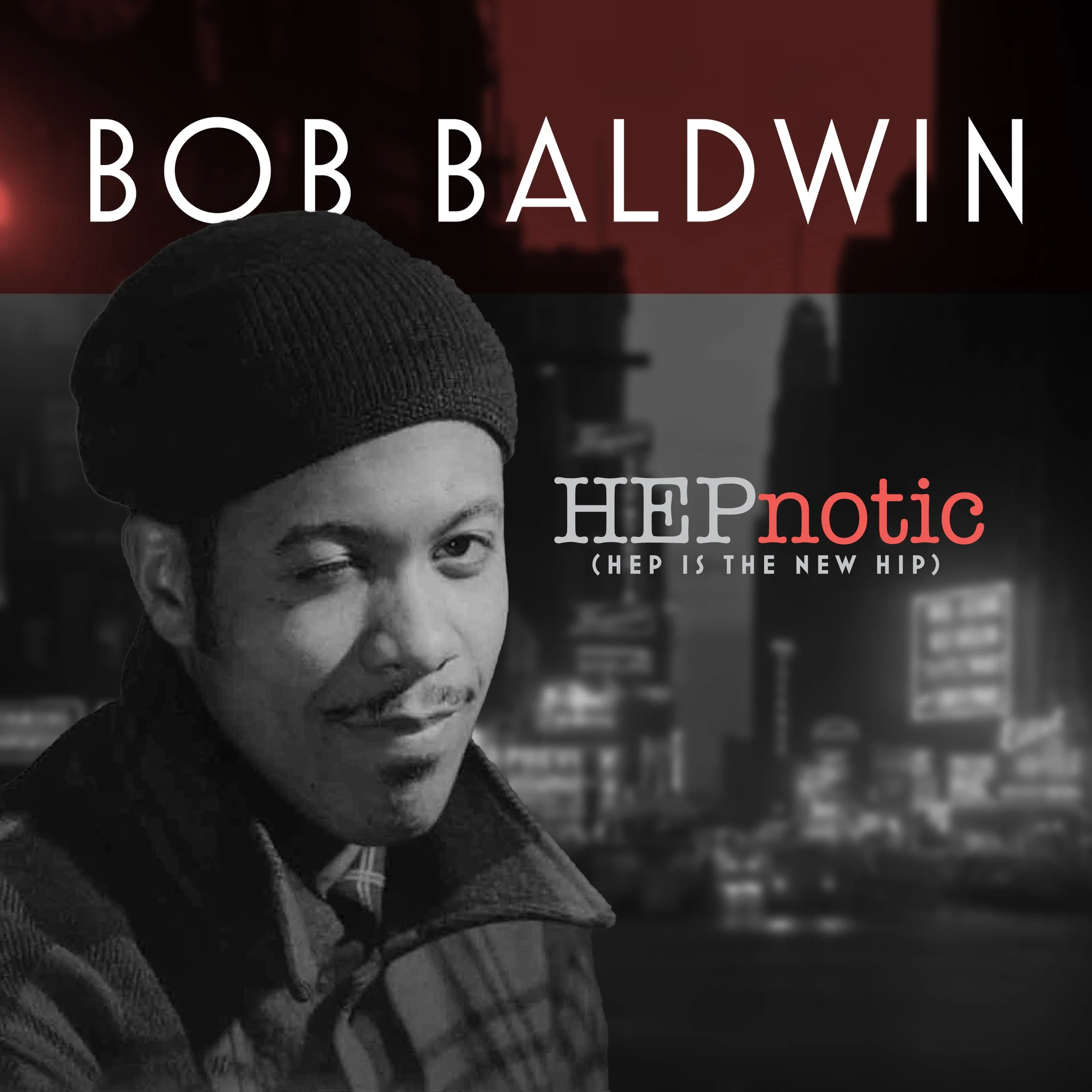
Selfie (Silhouette) of Bobby Baldwin in 1953. Cover art by Chris Drukker
Bobby Baldwin, Sr.
Music Biography
Bobby Baldwin, Sr. was born on May 22, 1926, in New Rochelle, New York. A gifted civil engineer by profession, Baldwin possessed a brilliant creative mind that extended far beyond technical work. Long before modern drafting technology existed, he hand-sketched schematic television designs and developed a deep passion for photography. Some of his photographic work would later become part of his family’s musical legacy, including his 1953 self-portrait featured on the 2026 Bob Baldwin release “Hepnotic / Hep is the New Hip – 100 Years of Cool,” as well as photography appearing on Bob Baldwin, Jr.’s debut recording I’ve Got a Long Way to Go, which captured the young Baldwin standing beside an oversized water fountain at Untermyer Park in Yonkers, New York.
Baldwin discovered his love for music during middle school, quickly developing into a talented acoustic bassist and pianist. By his senior year at high school in Mount Vernon, New York, he was already performing jazz standards from the 1940s and 1950s with remarkable skill and maturity.
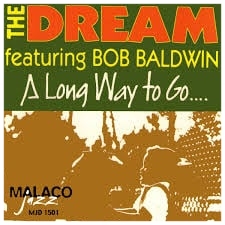
Cover picture by Baldwin, Sr.
1965, Untermyer Park, Yonkers, NY. Cover of Bob Baldwin’s debut disc, released in 1987.
Recalling his father’s influence, Bob Baldwin, Jr. says:
“In my single-digit years, the music coming through the living room stereo was Oscar Peterson, Miles Davis, Dizzy Gillespie, Wynton Kelly, Erroll Garner and other jazz greats. It was a rich musical jazz soundtrack every day in the house. it was where I learned how to play jazz.”
From 1941 to 1945, Baldwin served in the United States Navy during World War II, where he performed in the Navy Jazz Band. He narrowly escaped deployment connected to the Pearl Harbor conflict near the close of the war. After completing his military service, Baldwin returned to Westchester County, living primarily in New Rochelle and Mount Vernon while continuing to pursue his musical ambitions throughout the thriving New York jazz community.
During the 1940s through the 1960s, jazz flourished throughout Westchester County and nearby New York City. Baldwin became immersed in that vibrant musical culture, working alongside numerous respected artists of the era. He performed briefly with South African trumpeter Hugh Masekela during the 1960s and also apprenticed under legendary photographer Gordon Parks, the groundbreaking first African American photographer for Life magazine.
Throughout Westchester County, Baldwin collaborated with several notable regional jazz musicians, including saxophonist Jimmy Hill, trumpeter Fred Smith, pianist Lou Derry of New Rochelle, and saxophonist Carmen Leggio, among others.
Bob Baldwin, Jr. vividly remembers one unforgettable moment from the mid-1960s:
“I remember when I was about six years old when piano legend Billy Taylor called my father needing an upright bass player immediately for Carnegie Hall in New York City. Pop accepted the job, jumped into a yellow cab from Yonkers, and had the time of his life performing with Dr. Taylor.”
Baldwin, Jr. also recalls his father’s connection to jazz royalty during the family’s years in Yonkers:
“Dad met Ella Fitzgerald, who was living in Yonkers at the time around 1960, and he was deeply honored by the experience. Although they never performed together, he became close friends with her then-husband, bassist Keter Betts, and they later performed many duo engagements throughout Westchester and New York City.” The late Ella has a statue at the Yonkers, NY train station today.
Another defining musical relationship came through legendary bassist Art Davis, best known for his work with John Coltrane.
“I think the highlight of my young life was around 1971 when I realized the great bassist Art Davis — the last known bassist for John Coltrane before he passed — was performing with my father. They played duo gigs throughout Westchester and New York City. One afternoon I visited Mr. Davis’ house with Dad, and we encountered a young Max Roach there. The three of them started jamming together in the living room. I nearly passed out listening to that level of greatness at such a young age. Dad was truly in his element.”
By the early 1970s, discussions had begun about Bobby Baldwin, Sr. touring professionally with either Keter Betts or Art Davis. While balancing his engineering career and family responsibilities at age 46, tragedy suddenly struck. Baldwin contracted encephalitis, which severely damaged his central nervous system and permanently ended his ability to perform music.
Despite his immense talent and deep connections throughout the jazz world, Bobby Baldwin, Sr. never had the opportunity to professionally record his own music or arrangements.
His dream, however, would continue through his son.
Having studied music under his father since the age of four, Bob Baldwin, Jr. made a promise that if he ever had the opportunity to record professionally, he would carry forward the musical vision his father never had the chance to fully realize. Since 1987, Baldwin, Jr. has faithfully honored that promise, building an internationally respected recording career with annual releases spanning decades.
Reflecting on that bond, Baldwin, Jr. says:
“My dad and I are both God-fearing believers, and I know he’s smiling down on me, using the gift he passed on to me.”
Bobby Baldwin, Sr. passed away in 2008 at the age of 82 in New Rochelle, New York, just days after his birthday. Though he never recorded his own voice as an artist, his spirit, musicianship, and legacy continue to resonate through the music of his son — ensuring that Bobby Baldwin’s music and influence live on for generations to come.